

 Deutsch
 Español
 Suomi
Suomi Français
 Bahasa Indonesia
 Italiano
 日本語
日本語 Português
 Tagalog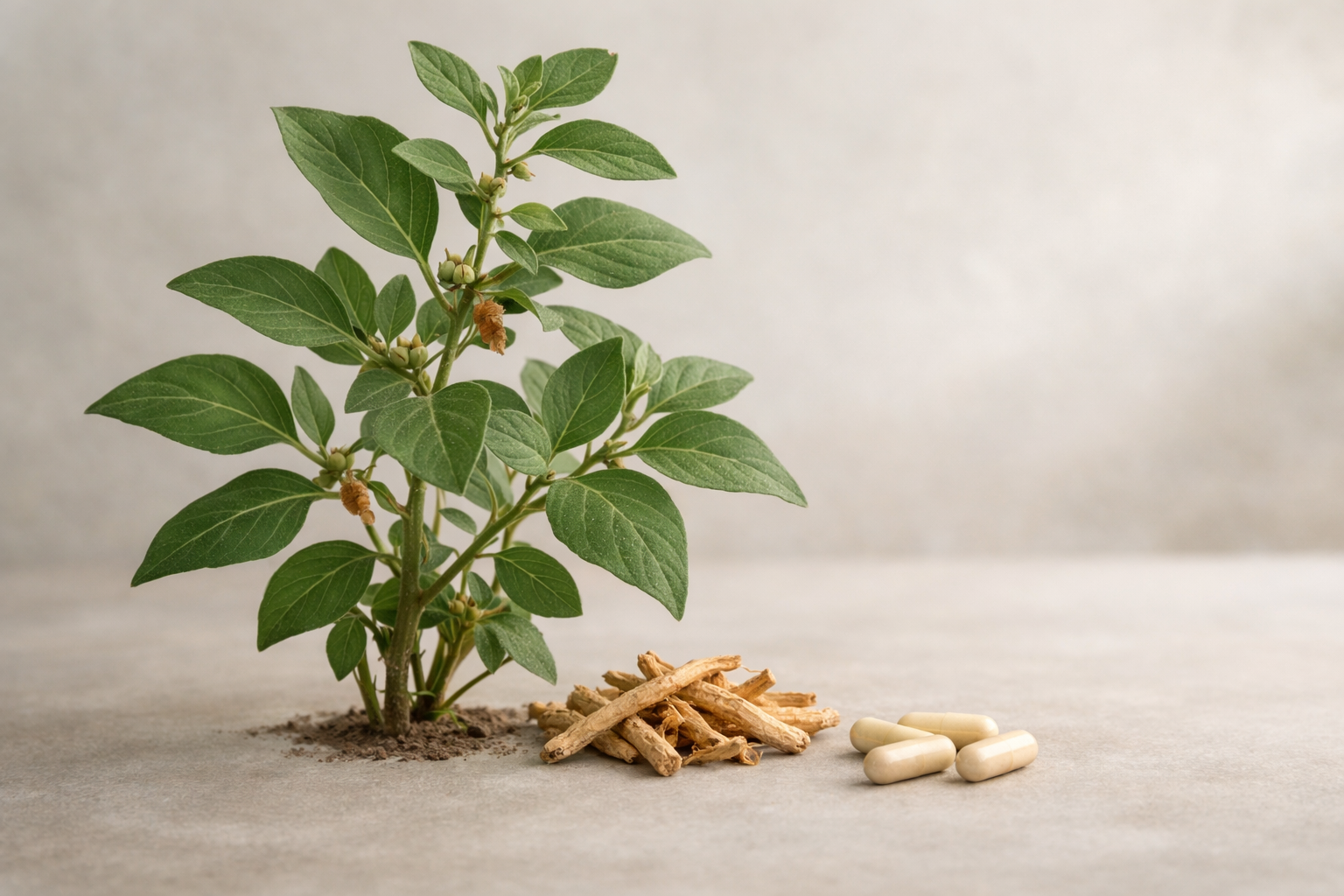
Summary
Ashwagandha is a botanical supplement, usually made from Withania somnifera root extract, and is most often used for stress support, relaxation, sleep, and vitality. It is not an essential nutrient, and product forms vary enough that root powder, root extract, and root-plus-leaf products should not be treated as interchangeable.
Current human evidence most strongly supports modest short-term benefits for perceived stress, with a reasonable secondary case for sleep support when standardized extracts are used for several weeks. Evidence for anxiety, exercise performance, cognition, testosterone, and fertility is more mixed or still emerging. Short-term use is often tolerated, but rare liver injury, thyroid effects, interactions, and product-quality differences are important practical concerns.
Quick Facts
What is it useful for?
Ashwagandha is mainly used for stress support, and some evidence also suggests modest sleep benefits with short-term standardized extracts.
Supplement types
Products may contain whole root powder, concentrated root extract, or root-plus-leaf extract, and these forms are not clinically interchangeable.
Interactions
It may add to the effects of sedative herbs, thyroid-support products, or supplements that lower blood sugar or blood pressure.
Side effects
Common short-term effects include stomach upset, nausea, loose stools, drowsiness, and headache, while rare liver injury is a more serious concern.
Other possible benefits
Research is exploring anxiety, exercise performance, cognition, testosterone, and fertility, but these uses remain less certain than stress support.
Regulatory status
In the US it is sold as a dietary supplement without premarket drug approval; in Europe claims are restricted and some countries take a stricter stance.
What We Already Know About It
Best-established use. The clearest human evidence for ashwagandha is in stress support. Across official summaries and recent meta-analyses, the most consistent finding is a modest reduction in perceived stress scores, with some studies also reporting lower cortisol, a hormone involved in the body’s stress response. Sleep is the next most credible area, especially when standardized extracts are used at around 600 mg per day for several weeks.
How it may work. Researchers mainly focus on withanolides and related compounds, along with broader effects on neuroendocrine signaling, inflammation, oxidative stress, and sleep-stress biology. In practical terms, the proposed idea is that ashwagandha may reduce physiological strain in some people, which could indirectly support mood, sleep, and recovery. That broader pattern helps explain why signals appear across stress, sleep, and some exercise studies rather than in only one body system.
What remains uncertain. Product differences make interpretation difficult. Plant part, extract method, withanolide content, and dose vary widely, so results from one trial cannot simply be transferred to every capsule or gummy on the market. Evidence for anxiety, cognition, testosterone, fertility, and athletic performance is promising in places but still limited by small samples, short trial duration, and inconsistent standardization. Long-term safety is also not well established, and thyroid and liver concerns show that this is a biologically active supplement.
Summary of Relevant Scientific Research
Stress Reduction Signal — 2024 systematic review and meta-analysis
Pooled randomized evidence found significant improvements versus placebo in perceived stress, Hamilton anxiety scores, and serum cortisol. The findings support a real but modest stress-related effect, while still reflecting a small and heterogeneous study base. (PubMed — 2024 stress and anxiety meta-analysis)
Sleep and Insomnia Outcomes — Systematic reviews
Recent reviews suggest some ashwagandha extracts may improve sleep quality or insomnia-related outcomes in adults, especially when standardized products are used for several weeks. The evidence is promising, but larger and longer trials are still needed. (PubMed — stress and anxiety review; PubMed — insomnia review)
Exercise Performance Findings — PubMed and Nutrition & Metabolism
A small meta-analysis and later review suggest possible improvements in VO2max and related aerobic outcomes, with some studies also reporting benefits for strength, power, or recovery. The evidence remains limited and should not be generalized to all products or users. (PubMed — exercise performance meta-analysis; Nutrition & Metabolism — sports performance review)
Cognition and Reproductive Health — Small trial and 2024 review
A 30-day trial in stressed adults found improvements in mood and cognitive outcomes at 225 mg and 400 mg daily, while a 2024 review found somewhat more consistent evidence for male sperm-quality outcomes than for female reproductive outcomes. Both areas remain emerging. (PubMed — cognition trial in stressed adults; PubMed — reproductive health review)
Thyroid Effect as a Biological Signal — Randomized trial in subclinical hypothyroidism
An 8-week placebo-controlled trial using 600 mg per day of root extract changed TSH, T3, and T4 in a direction that suggested thyroid stimulation or normalization. The study is too small to justify self-treatment, but it does show pharmacologically meaningful endocrine activity. (PubMed — subclinical hypothyroidism trial)
Beliefs, Myths & Unproven Claims
Myth: Ashwagandha helps almost everything
A common belief is that ashwagandha broadly improves stress, sleep, hormones, energy, muscle, fertility, and cognition in almost anyone. The reviewed evidence does not support that sweep. The strongest support remains stress-related outcomes and possibly sleep, while many other marketed uses are still preliminary, inconsistent, or population-specific. (NIH ODS — Ashwagandha Fact Sheet; NCCIH — Ashwagandha Usefulness and Safety)
Myth: It is a proven testosterone or fertility booster
The literature is more nuanced than marketing claims suggest. Some studies point to possible benefits for male reproductive parameters, especially in infertility or subfertility settings, but that is not the same as proving a reliable hormone or fertility boost in healthy users. Evidence for female fertility and menopause claims is weaker still. (PubMed — reproductive health review; NCCIH — Ashwagandha Usefulness and Safety)
Myth: Natural means automatically gentle and safe
Ashwagandha is not risk-free simply because it is botanical. Rare liver injury has been reported, thyroid-related measures can change, and interactions are plausible with sedatives, immunosuppressants, thyroid medication, blood-pressure drugs, and glucose-lowering medication. The responsible conclusion is caution, not automatic reassurance. (LiverTox — Ashwagandha; TGA Australia — Withania somnifera safety alert; PubMed — subclinical hypothyroidism trial; NCCIH — Ashwagandha Usefulness and Safety)
Detailed Research Observations
Forms and Standardization Shape the Evidence
Ashwagandha is sold in several non-equivalent forms, including whole root powder, concentrated root extract, and root-plus-leaf extracts. That matters because the clinical evidence does not apply evenly across these categories. Trial data most often cluster around standardized extracts rather than generic powders or proprietary blends, and higher gram-level amounts of whole root should not be assumed to match lower extract doses by effect or potency. Products that do not clearly identify the plant part, extract ratio, or standardized withanolide content make it difficult to compare label claims with the products actually used in human studies. In practical terms, formulation differences are one reason a positive study cannot automatically validate every supplement on a store shelf. (NIH ODS — Ashwagandha Fact Sheet; USP — Ashwagandha root powder monograph preview)
This also explains why dosing comparisons can be misleading. A commonly studied standardized extract range is roughly 240 to 600 mg per day over 6 to 12 weeks, often as 300 mg twice daily, while official summaries also mention broader ranges up to 1,250 mg of extract or about 6 g of root-powder equivalent. Those figures are not directly interchangeable because concentration and phytochemical profile differ across products. The practical lesson from the literature is to prefer clearly labeled, single-ingredient products that resemble the extracts used in trials rather than vague blends with unclear identity. (NIH ODS — Ashwagandha Fact Sheet; PubMed — stress and anxiety review)
Stress and Sleep Are the Strongest but Still Modest Signals
If the evidence is ranked by credibility, stress support comes first. Recent meta-analytic evidence suggests improvements in perceived stress and some anxiety-related scales compared with placebo, and some studies also report reductions in cortisol. That matters because the signal is not only subjective; it also appears in a biological marker tied to the stress response. Even so, the average effect appears modest rather than dramatic, and the studies remain limited by short duration, small samples, and differing extracts. The literature supports cautious optimism, not a blanket claim that all ashwagandha products reliably reduce stress in everyone. (PubMed — 2024 stress and anxiety meta-analysis; PubMed — stress and anxiety review; NIH ODS — Ashwagandha Fact Sheet)
Sleep is the next most credible use-case. Official summaries and systematic reviews suggest some ashwagandha preparations may improve sleep quality or insomnia-related outcomes, especially around 600 mg per day and after at least 8 weeks of use. But the reviewed sources do not justify presenting ashwagandha as a proven treatment for chronic insomnia. Part of the sleep signal may also reflect indirect stress reduction rather than a direct sedative mechanism, which fits the broader pattern of the literature. (NCCIH — Ashwagandha Usefulness and Safety; NIH ODS — Ashwagandha Fact Sheet; PubMed — insomnia review)
Thyroid and Liver Findings Show Real Biological Activity
One of the most important observations in the literature is that ashwagandha is not metabolically inert. In a placebo-controlled trial in adults with subclinical hypothyroidism, 600 mg per day of root extract changed TSH, T3, and T4 in a direction suggesting thyroid stimulation or normalization. That result is scientifically interesting, but it should not be turned into casual self-treatment advice. Instead, it highlights that the supplement can have endocrine effects that may matter for people with thyroid disease, hyperthyroid tendencies, palpitations, or thyroid medication use. (PubMed — subclinical hypothyroidism trial; NCCIH — Ashwagandha Usefulness and Safety; ANSES France — safety opinion on ashwagandha)
Safety data also include a rare but credible liver-injury signal. Short-term trials often report tolerability, with stomach upset, nausea, loose stools, drowsiness, and headache among the more common complaints. The more serious concern comes from case reports and regulator warnings describing cholestatic or mixed liver injury that often begins within 2 to 12 weeks of starting use. These sources do not establish a precise incidence rate, but they do make clear that “natural” is not the same as harmless. Consumers should know warning signs such as jaundice, dark urine, unusual fatigue, abdominal pain, nausea, vomiting, or loss of appetite. (LiverTox — Ashwagandha; TGA Australia — Withania somnifera safety alert; NCCIH — Ashwagandha Usefulness and Safety)
Quality Control and Regulation Matter in Real-World Use
Quality is a central practical issue for ashwagandha because product identity and composition are not guaranteed by the front label alone. USP’s monograph preview shows that ashwagandha root powder can be standardized, including defined quality parameters, but market research has also found adulteration problems. A DNA barcoding study reported more adulteration in powders than in root samples, and FDA enforcement documented raw-material contamination and quality-control failures in at least one manufacturer. These findings do not mean all products are poor quality, but they do support choosing supplements that clearly state the plant part, avoid vague proprietary blends, and come from manufacturers with meaningful testing systems. (USP — Ashwagandha root powder monograph preview; PubMed — DNA barcoding market study; FDA — warning letter on raw material quality failures)
The market context adds another layer of caution. In the United States, ashwagandha is generally sold under the dietary supplement framework, so legal sale does not mean premarket proof of efficacy, safety, or purity. In Europe, disease claims are more tightly restricted, the reviewed sources did not verify an ashwagandha-specific authorized EU health claim, and country-level positions vary. France has issued a precautionary safety opinion, while Denmark has taken the strongest stance among the reviewed sources by prohibiting sales. This uneven landscape reflects ongoing uncertainty in both evidence and risk management. (FDA — dietary supplements questions and answers; EMA — Withania somnifera root statement; ANSES France — safety opinion on ashwagandha; Danish Veterinary and Food Administration — ashwagandha sales position)
Regulatory Status (EU and US)
United States
In the United States, ashwagandha is generally sold as a dietary supplement under the supplement framework rather than the drug approval system. That means products are not approved before marketing in the same way as drugs, and legal sale should not be taken as proof of effectiveness, safety, or product quality. Structure-function style claims may appear on labels, but they are not the same as approved drug claims.
European Union
In Europe, foods and supplements cannot legally be marketed as preventing, treating, or curing disease, and the reviewed sources did not verify an ashwagandha-specific authorized EU health claim. EMA did not adopt a standard EU herbal monograph for Withania somnifera root, and national positions vary. France’s ANSES has issued a precautionary safety opinion, while Denmark has taken a notably stricter stance by prohibiting sales.
Dosage and Standardization
Most human trials use standardized extract at roughly 240 to 600 mg daily for 6 to 12 weeks, often 300 mg twice daily. Some studies go up to 1,250 mg of extract or about 6 g root-powder equivalent, but these are not directly comparable because extract strength, plant part, and withanolide content differ.
Safety And Interactions
Short-term ashwagandha use appears generally well tolerated in many studies, but common side effects can include stomach upset, nausea, loose stools, drowsiness, and headache. The better-established serious concern is rare liver injury, so use should be stopped and medical advice sought if jaundice, dark urine, persistent nausea, vomiting, unusual fatigue, abdominal pain, or loss of appetite appear after starting it.
Thyroid caution is also important because a clinical trial found meaningful changes in TSH, T3, and T4, so people with thyroid disease or thyroid medication use should be cautious. Practical interaction concerns include additive sedation with sedatives or anticonvulsants, altered response with thyroid hormone medication, possible additive effects with blood-pressure or glucose-lowering medicines, and conflict with immunosuppressants. Pregnancy should be treated as a do-not-use situation, breastfeeding should be avoided because of insufficient safety data, and ANSES additionally recommends avoidance in children under 18 and in people with liver, cardiac, or thyroid disease.
Conclusion
Ashwagandha is best understood as a biologically active botanical supplement, not an essential nutrient and not a cure-all. The current evidence is strongest for modest improvements in perceived stress, with a reasonable secondary case for sleep support in some adults using standardized extracts over several weeks. Evidence for anxiety, exercise performance, cognition, testosterone, and fertility is promising in places but still limited, product-specific, and not strong enough to justify broad marketing claims.
The biggest practical cautions are product quality, formulation differences, rare liver injury, thyroid-related effects, and the potential for interactions with common medications. Regulatory context also matters: US sale does not mean FDA preapproval, European disease claims are restricted, and some countries take a much more precautionary position than others. For most consumers, the balanced takeaway is straightforward: if ashwagandha is used at all, it should be chosen carefully, used conservatively, and avoided or medically reviewed in higher-risk groups.
Disclaimer
Disclaimer: We attempt to do our best to find relevant, accurate and most up to date information available in both, the public domain and in the clinical and medical research community. We recommend reviewing scientific sources for official information on the subject. This post is not intended as medical advice. Each individual person's health conditions vary and we advise to consult a doctor before taking any supplements.