

 Deutsch
 Español
 Suomi
Suomi Français
 Bahasa Indonesia
 Italiano
 日本語
日本語 Português
 Tagalog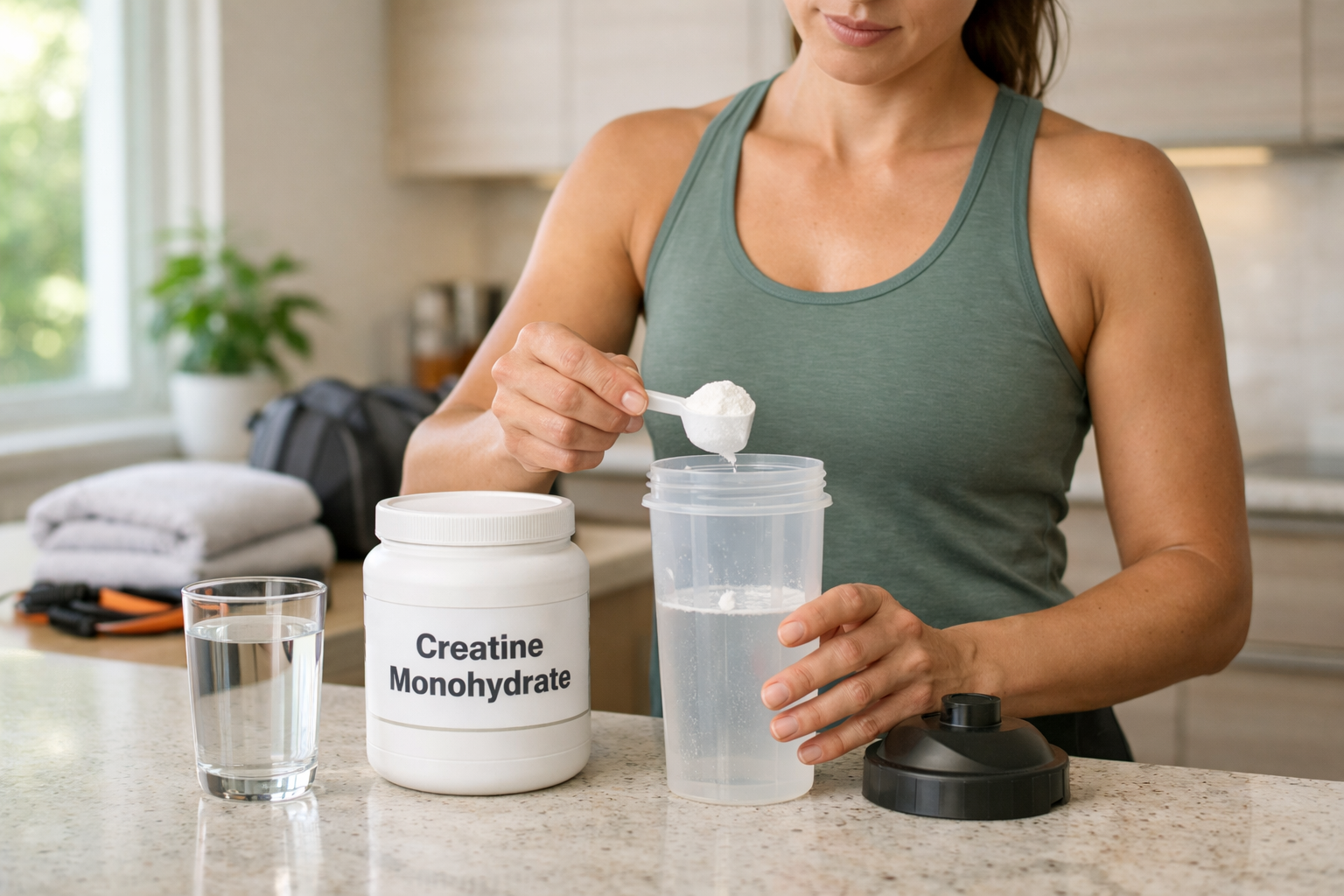
Summary
Creatine is a naturally occurring compound stored mainly in muscle, where it helps recycle ATP during short, intense effort. Among the many products sold, creatine monohydrate has by far the strongest and most consistent evidence for improving repeated high-intensity performance, supporting greater strength gains, and increasing lean mass when combined with resistance training.
Evidence beyond that core use is more mixed. Research on recovery, healthy aging, and some cognitive domains is promising but less settled, while pure endurance benefits are not well supported. For most adults, plain creatine monohydrate is the evidence-based choice, with daily consistency mattering more than premium formulations or exact workout timing.
Quick Facts
What is it useful for?
Best supported for repeated short, high-intensity exercise and for improving strength and lean mass alongside resistance training.
Supplement types
Creatine monohydrate is the best-studied form. Alternative forms have not shown superior uptake or real-world efficacy.
Interactions
Carbohydrate or carbohydrate plus protein may improve creatine retention. Direct major drug interactions were not clearly established in the supplied literature, but multi-ingredient bodybuilding products can add risks.
Side effects
Early weight gain from water retention in muscle and occasional gastrointestinal upset are the main practical side effects reported at studied doses.
Other possible benefits
Possible added benefits include recovery support, healthy aging, and some cognitive domains, but evidence is less certain than for sports performance.
Regulatory status
In the EU, specific performance and older-adult strength claims are supported. In the US, creatine is sold as a dietary supplement without FDA preapproval.
What We Already Know About It
Core mechanism. Creatine increases muscle creatine and phosphocreatine stores, helping the body regenerate ATP more quickly during very short, intense efforts. The source article notes that supplementation can raise these stores by roughly 20 to 40 percent, which helps sustain repeated hard bouts of work and may allow slightly better training volume or quality over time. That energy-system effect is the main reason creatine is most strongly linked with better repeated high-intensity performance, greater strength gains during resistance training, and improved lean-mass outcomes when training is consistent. ISSN position stand on creatine; PubMed Central — 2024 strength meta-analysis; PubMed — 2024 body composition meta-analysis
Where certainty drops. Outside that core use case, the evidence becomes more mixed. Recovery support is biologically plausible and has some controlled support, but results are not as consistent as the strength literature. Cognitive effects are scientifically interesting because brain cells also rely on efficient energy handling, yet current human evidence is domain-specific rather than broad. Pure endurance performance is another limit: pooled research in trained endurance athletes does not show a significant overall benefit. Overall, the article describes the evidence as strong for high-intensity performance and resistance training, and more moderate to preliminary for recovery, healthy aging, and some cognitive applications. PubMed — exercise recovery meta-analysis; Frontiers in Nutrition — 2024 cognition meta-analysis; PubMed — 2023 endurance meta-analysis; Springer — 2025 older adults meta-analysis
Summary of Relevant Scientific Research
Most established performance evidence — International Society of Sports Nutrition
The position stand explains that creatine is stored mainly in muscle as free creatine and phosphocreatine, where it helps regenerate ATP during short, intense activity. It concludes that creatine monohydrate is the most effective ergogenic nutritional supplement currently available for increasing high-intensity exercise capacity and lean body mass during training, and it also outlines the standard loading and maintenance protocols still used in practice. ISSN position stand on creatine
Greater strength gains with training — 2024 meta-analysis
In adults under 50 doing resistance training, pooled studies found that creatine supplementation produced greater upper- and lower-body strength gains than placebo. The article presents this as one of the clearest real-world summaries of creatine’s value as a training-support supplement rather than a shortcut on its own. PubMed Central — 2024 strength meta-analysis
Lean mass is not just water weight — 2024 body-composition review
When combined with resistance training, creatine increased lean body mass by about 1.14 kg compared with training alone, while also modestly improving fat-related measures. This is important because it pushes back against the oversimplified claim that creatine only causes temporary water gain. PubMed — 2024 body composition meta-analysis
Cognition shows promise, not certainty — 2024 systematic review
Across 16 randomized controlled trials, creatine showed significant benefits in memory, attention time, and processing-speed time, but not in overall cognitive function or executive function. The article emphasizes that this supports cautious optimism rather than sweeping nootropic claims. Frontiers in Nutrition — 2024 cognition meta-analysis
Safety and kidney concerns in healthy adults — 2025 reviews
A large safety review covering 685 human clinical trials found no significant difference between creatine and placebo in overall side-effect prevalence or renal markers, and a separate 2025 kidney-function meta-analysis found non-significant differences in glomerular filtration rate. In the studied populations, these are strong counterpoints to routine kidney-harm claims in healthy adults. PubMed — 2025 safety review; PubMed — 2025 kidney meta-analysis
Beliefs, Myths & Unproven Claims
Newer or pricier forms must be better
The article says current evidence does not support the idea that buffered, hydrochloride, nitrate, or other premium creatine forms outperform monohydrate. Creatine monohydrate remains the reference form because it is the most studied, the most consistently effective, and the form other versions have generally failed to clearly beat in uptake, retention, or meaningful outcomes. Nutrients review — creatine forms and monohydrate; ISSN position stand on creatine
Creatine is only for bodybuilders or boosts every sport
The strongest evidence is for repeated high-intensity performance and resistance training, and the article also notes possible value for older adults when creatine is combined with exercise. But pooled evidence in trained endurance athletes does not support broad claims that creatine improves every type of sport equally. PubMed Central — 2024 strength meta-analysis; Springer — 2025 older adults meta-analysis; PubMed — 2023 endurance meta-analysis
Creatine is a proven nootropic or disease treatment
The article describes cognitive findings as credible but mixed, and notes that EFSA did not approve a cognitive-function claim for healthy adults. It also points to the negative Huntington’s disease trial summary as a reminder that plausible energy biology does not automatically become proven clinical treatment. Frontiers in Nutrition — 2024 cognition meta-analysis; EFSA opinion — cognition claim; NCCIH — CREST-E trial on Huntington’s disease
Creatine routinely damages kidneys or causes hair loss
The article says current meta-analytic kidney data do not support routine kidney harm in healthy studied populations, though people with kidney disease still need medical guidance. It also notes that the hair-loss story has long rested on indirect reasoning, and cites a 2025 randomized controlled trial that did not find evidence of hair loss over 12 weeks. PubMed — 2025 kidney meta-analysis; Mayo Clinic — creatine overview; Taylor & Francis — 2025 hair-loss trial
Detailed Research Observations
Creatine is an endogenous energy compound, not a stimulant
The article stresses that creatine is not a traditional herb or exotic stimulant. It is a compound the body makes from amino acid precursors and also gets in smaller amounts from foods such as meat and seafood. A typical diet supplies around 1 to 2 grams daily, while the body synthesizes more to help maintain stores. Roughly 95 percent of total body creatine is stored in skeletal muscle, and about two thirds of that is present as phosphocreatine. This matters because phosphocreatine acts as a rapid energy buffer during hard muscular effort, which helps explain why creatine has become one of the most researched performance supplements rather than a passing trend. Mayo Clinic — creatine overview; ISSN position stand on creatine
Its main mechanism is better phosphocreatine availability
According to the source article, creatine works by improving phosphocreatine availability so ATP can be regenerated more quickly during very short, intense work. In practice, it does not act like caffeine and does not directly stimulate the nervous system. Instead, it helps muscle maintain power output across repeated bouts such as sprint intervals, heavy sets, jumping, or repeated explosive actions in team sports. Over weeks and months, those small advantages may improve training quality, which likely helps explain the consistent findings on strength and lean mass. The article also notes possible secondary roles in cell hydration and recovery, but treats those as less central than the energy-system explanation. ISSN position stand on creatine; PubMed — exercise recovery meta-analysis
Creatine monohydrate remains the evidence-based default
The supplement market often presents newer forms as cleaner, more absorbable, or less likely to cause side effects, but the article says the review literature does not support broad superiority claims for these premium variants. Creatine monohydrate is still the best-supported form because it has the deepest evidence base for efficacy, safety, dosage, and regulatory acceptance. Alternative forms are often less studied, more expensive, or promoted mainly through marketing rather than convincing head-to-head outcome data. For consumers, the article’s practical message is straightforward: plain creatine monohydrate remains the default evidence-based choice rather than something to trade up from. Nutrients review — creatine forms and monohydrate; ISSN position stand on creatine
The strongest outcomes are performance, strength, and lean mass
This is the area where the article says creatine is at its strongest scientifically. EFSA recognizes a cause-and-effect relationship between creatine consumption and improved physical performance during successive bursts of short-term, high-intensity exercise. Meta-analyses add practical detail by showing that, when combined with resistance training, creatine improves maximal strength and leads to greater lean-mass gains than training alone. The article also points out that this does not mean creatine magically builds muscle by itself. Rather, the best interpretation is that it helps many people train harder and adapt better over time. Older adults are also highlighted as a relevant group when creatine is paired with exercise, especially resistance training. EFSA opinion — high-intensity performance claim; PubMed Central — 2024 strength meta-analysis; PubMed — 2024 body composition meta-analysis; Springer — 2025 older adults meta-analysis; EFSA opinion — adults over 55 strength claim
The limits matter: endurance, cognition, and disease claims need restraint
The article argues that creatine is often oversold beyond its strongest use cases. In trained endurance populations, pooled research does not show a significant overall benefit for pure endurance performance, which means broad endurance claims should be toned down. Cognitive findings are more nuanced as well: the latest meta-analysis suggests benefits in memory and some speed-related tasks, but not in overall cognition or executive function, and evidence certainty is mixed. An acute sleep-deprivation study is described as especially interesting because it suggests a brain-energy effect under stress, but the article is clear that this is not the same as proof of everyday nootropic benefits. It extends the same caution to disease treatment claims, noting that a major Huntington’s disease trial was negative. PubMed — 2023 endurance meta-analysis; Frontiers in Nutrition — 2024 cognition meta-analysis; PubMed — sleep deprivation and brain-energy study; NCCIH — CREST-E trial on Huntington’s disease
Practical use is simple, but product quality and special populations still matter
The article presents monohydrate as well absorbed and effective enough that the most important practical variables are consistency, dose, and product quality rather than exotic formulation. Co-ingesting creatine with carbohydrate or carbohydrate plus protein may improve retention, but any real-world outcome advantage over taking monohydrate alone remains unclear. Loading can saturate stores faster, but it is optional, and steady daily intake is often simpler and easier on the stomach. The article also highlights a marketplace issue: FDA and NCCIH warn that some bodybuilding products may be adulterated or otherwise risky, so a plain single-ingredient product is the lower-complexity choice. Evidence is also thinner for adolescents, pregnancy, breastfeeding, and people with kidney disease or other medical complexity, so those groups warrant more cautious, clinician-led decisions. ISSN position stand on creatine; PubMed — creatine timing review; FDA consumer update — risky bodybuilding products; NCCIH — bodybuilding and performance supplements; PubMed — review on special populations
Regulatory Status (EU and US)
European Union
In the EU, creatine has narrowly defined, evidence-backed claim contexts. EFSA concluded that creatine can increase physical performance during successive bursts of short-term, high-intensity exercise, and it also accepted a separate claim that daily creatine combined with resistance training can enhance muscle strength in adults over 55 years of age. EFSA did not establish a cause-and-effect relationship for improved cognitive function in healthy adults, so broad brain-health claims are not supported in Europe. EFSA opinion — high-intensity performance claim; EFSA opinion — adults over 55 strength claim; EFSA opinion — cognition claim
United States
In the US, creatine is regulated as a dietary supplement under DSHEA, which means the FDA does not preapprove products for safety and effectiveness before marketing. The article emphasizes that this makes product quality important, especially because FDA and NCCIH both warn that some bodybuilding products may contain undeclared or risky ingredients. FDA — dietary supplement information; FDA consumer update — risky bodybuilding products; NCCIH — bodybuilding and performance supplements
Dosage and Standardization
Typical use: 3 to 5 g of creatine monohydrate daily is the simplest maintenance dose.
Optional loading: about 0.3 g/kg/day split into four doses for 5 to 7 days, then 3 to 5 g daily. Larger or more muscular people may sometimes use 5 to 10 g daily. Consistency matters more than exact timing.
Safety And Interactions
In healthy adults using studied doses, creatine appears generally safe, and large evidence syntheses do not show a meaningful increase in overall adverse effects compared with placebo. The most common practical issues are early weight gain, often due in part to water retention inside muscle, and occasional gastrointestinal upset, especially with higher loading doses or poorly split servings. Evidence that creatine routinely causes dehydration or cramping is not strong. PubMed — 2025 safety review; Mayo Clinic — creatine overview; ISSN position stand on creatine
Current meta-analytic evidence does not support measurable kidney-function decline in healthy studied populations, but people with kidney disease or kidney-risk conditions should use medical guidance. Pregnancy, breastfeeding, and pediatric or adolescent use are also areas with much thinner evidence, so a cautious, supervised approach is more appropriate. PubMed — 2025 kidney meta-analysis; NCCIH — bodybuilding and performance supplements; PubMed — review on special populations
Direct evidence for major creatine-specific drug interactions was limited in the supplied literature. The more practical safety concern is product context: multi-ingredient bodybuilding products may contain stimulants, undeclared drugs, or steroid-like compounds, and those risks can be wrongly blamed on creatine itself. Carbohydrate or protein may improve creatine retention, but this is not presented as a major safety issue. FDA consumer update — risky bodybuilding products; FDA — dietary supplement information; ISSN position stand on creatine
Conclusion
Creatine monohydrate is one of the few supplements with a genuinely evidence-based reputation. Its strongest support is for repeated short-duration high-intensity performance, greater strength gains during resistance training, and modest but meaningful improvements in lean mass when training is in place.
Beyond that core, the picture is more nuanced. Recovery support, healthy-aging applications, and some cognitive benefits are credible but less settled, while sweeping endurance, nootropic, and premium-form claims are not well supported. For most adults whose goals match the evidence, plain creatine monohydrate at a consistent daily dose is the best-supported approach.
Disclaimer
Disclaimer: We attempt to do our best to find relevant, accurate and most up to date information available in both, the public domain and in the clinical and medical research community. We recommend reviewing scientific sources for official information on the subject. This post is not intended as medical advice. Each individual person's health conditions vary and we advise to consult a doctor before taking any supplements.