

 Deutsch
 Español
 Suomi
Suomi Français
 Bahasa Indonesia
 Italiano
 日本語
日本語 Português
 Tagalog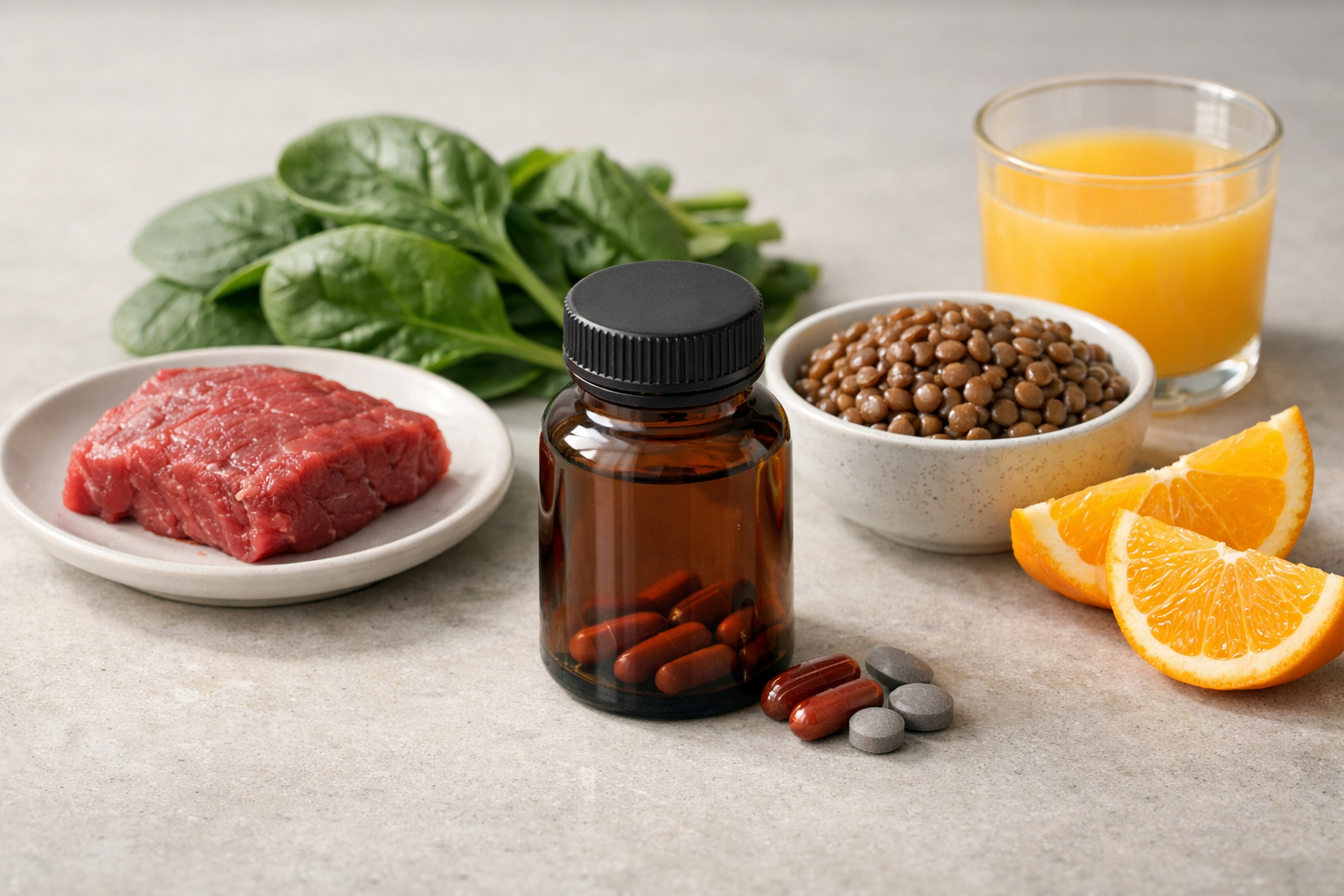
Summary
Iron is an essential mineral needed for hemoglobin, myoglobin, neurological development, energy metabolism, and multiple enzyme systems. As a supplement, it is most strongly supported for preventing or correcting documented iron deficiency and iron-deficiency anemia, especially in higher-risk groups such as people with heavy menstrual losses, pregnancy-related needs, frequent blood donation, or some gastrointestinal disorders.
The article emphasizes that absorption matters as much as dose. Heme iron is generally absorbed better than nonheme iron, while vitamin C, meal composition, stomach acid, inflammation, and dose timing can change response. Iron therefore has a strong evidence base, but it is better used as targeted repletion than as a routine energy supplement for anyone who feels tired.
Quick Facts
What is it useful for?
Preventing or correcting iron deficiency and iron-deficiency anemia, and supporting normal oxygen transport when iron intake or stores are low.
Supplement types
Common forms include ferrous sulfate, ferrous gluconate, ferric citrate, carbonyl iron, polysaccharide-iron complexes, heme iron products, and specialty products such as ferric maltol.
Interactions
Iron can interact with calcium, antacids, levothyroxine, levodopa, zinc, and acid-suppressive drugs, while vitamin C can improve nonheme iron absorption.
Side effects
Common side effects include nausea, abdominal discomfort, constipation, diarrhea, and dark stools. Overdose in children can be life-threatening.
Other possible benefits
Iron may reduce fatigue in some nonanemic menstruating women with low ferritin, but broader benefits for quality of life or physical performance are less consistent.
Regulatory status
In the EU, only specific function claims are authorized for iron. In the U.S., iron supplements are sold under dietary supplement rules and solid oral products require a child-overdose warning.
What We Already Know About It
Essential role. Iron is clearly essential for oxygen transport through hemoglobin, oxygen storage in myoglobin, neurological development, energy-yielding metabolism, and multiple enzyme systems. Unlike nutrients that can be actively excreted, iron balance is controlled mainly through absorption and distribution, so the body has to regulate it tightly rather than simply eliminate excess. NIH ODS — Iron Health Professional Fact Sheet
Hepcidin control. The hepcidin-ferroportin system is the central regulator of that balance. When hepcidin rises, iron absorption from the intestine and release from body stores fall; when it falls, both increase. This helps explain why inflammation, infection, and some chronic diseases can create iron restriction or a poor response to oral iron even when intake seems adequate. PubMed — Camaschella, Nai and Silvestri on iron metabolism
Bioavailability matters. Heme iron from meat and seafood is generally absorbed better than nonheme iron from beans, grains, vegetables, and fortified foods. Vitamin C and meat can improve nonheme absorption, whereas phytates, polyphenols, calcium, and acid suppression can reduce it. That is why the strongest evidence supports targeted supplementation for documented deficiency, while evidence for broad wellness, performance, or routine fatigue claims is much narrower. PubMed — Hurrell and Egli on iron bioavailability; PubMed — Vaucher et al. fatigue trial; PubMed — Houston et al. systematic review
Summary of Relevant Scientific Research
Baseline Iron Physiology and Safety — NIH Office of Dietary Supplements
The NIH fact sheet summarizes iron as essential for hemoglobin, myoglobin, neurological development, connective tissue, cellular function, and hormone synthesis. It also outlines common supplement forms, key deficiency risk groups, interactions, and frequent gastrointestinal side effects. NIH ODS — Iron Health Professional Fact Sheet
Bioavailability Depends on Diet Context — Hurrell and Egli review
This review explains that the iron listed in food is not the same as the amount absorbed. It estimated about 14 to 18% bioavailability for mixed diets and 5 to 12% for vegetarian diets, while showing that vitamin C and meat enhance nonheme absorption and phytates, polyphenols, and calcium can inhibit it. PubMed — Hurrell and Egli on iron bioavailability
Alternate-Day Dosing Looks Promising — Stoffel et al. and 2025 meta-analysis
In iron-depleted women, alternate-day single morning dosing improved fractional absorption compared with consecutive-day or split dosing, likely because repeated doses raise hepcidin. A later meta-analysis found the overall certainty still low, so regimen choice remains individualized. PubMed — Stoffel et al. alternate-day dosing study; PubMed — 2025 meta-analysis on alternate-day dosing
Fatigue Relief in Low-Ferritin Women — Vaucher et al. and Houston et al.
In menstruating women with fatigue, ferritin below 50 mcg/L, and normal hemoglobin, oral ferrous sulfate improved fatigue over 12 weeks compared with placebo. A systematic review found improvements in ferritin, hemoglobin, and fatigue in nonanemic iron-deficient adults, but objective physical-capacity benefits were less consistent. PubMed — Vaucher et al. fatigue trial; PubMed — Houston et al. systematic review
Specialty Oral Iron for Selected IBD Patients — Ferric maltol phase 3 trial
In adults with inflammatory bowel disease, mild-to-moderate iron-deficiency anemia, and previous failure on standard oral ferrous products, ferric maltol 30 mg twice daily improved hemoglobin versus placebo over 12 weeks. The finding supports selected specialty use rather than broad superiority for routine consumers. PubMed — Ferric maltol phase 3 trial
Beliefs, Myths & Unproven Claims
Myth: Iron boosts energy for anyone who feels tired
This claim is too broad. Iron can reduce fatigue when low iron is actually part of the problem, but the better evidence is for people with documented low stores or deficiency. In nonanemic adults, the clearest data are in menstruating women with low ferritin, and even there the benefit is stronger for subjective fatigue than for mood, quality of life, or objective performance. PubMed — Vaucher et al. fatigue trial; PubMed — Houston et al. systematic review
Myth: Higher doses always work better
Newer dosing research suggests that repeated or closely spaced doses can sometimes work against absorption by raising hepcidin. Lower, once-daily, or alternate-day schedules may improve tolerance and in some settings improve fractional absorption, so the older more-is-better mindset is no longer well supported. PubMed — Stoffel et al. alternate-day dosing study; PubMed — 2025 meta-analysis on alternate-day dosing; Gut — British Society of Gastroenterology guideline
Myth: Premium iron forms are automatically superior
Current guidance does not show clear clinical-trial superiority for many alternative oral products over standard preparations such as ferrous sulfate. Specialty products can matter in selected settings, such as ferric maltol in inflammatory bowel disease after standard oral failure, but that is different from proving that premium forms are broadly better for the average supplement buyer. AGA Clinical Practice Update — Oral iron supplementation; PubMed — Ferric maltol phase 3 trial; NIH ODS — Iron Health Professional Fact Sheet
Detailed Research Observations
Biological Role and Iron Economy
Iron is indispensable for carrying oxygen in hemoglobin, storing oxygen in myoglobin, supporting neurological development, and enabling multiple metabolic and enzymatic processes. Most body iron is found in hemoglobin, and the body recycles much of it rather than losing it each day. Because there is no meaningful physiologic pathway for active iron elimination, iron balance depends far more on controlled absorption and distribution than on excretion. NIH ODS — Iron Health Professional Fact Sheet
The hepcidin-ferroportin system is central to that control. High hepcidin limits intestinal absorption and release of stored iron, while low hepcidin allows the opposite. This framework helps explain both iron deficiency and iron overload, and it also explains why inflammation can create functional iron restriction even when dietary intake does not look obviously low. PubMed — Camaschella, Nai and Silvestri on iron metabolism
Bioavailability Depends on Food Form and Meal Context
Iron in food comes in heme and nonheme forms, and the difference matters in practice. Heme iron from meat and seafood is generally absorbed more efficiently than nonheme iron from beans, lentils, grains, vegetables, and fortified foods. Reviews cited in the article estimate higher overall bioavailability in mixed diets than in vegetarian diets, partly because meat enhances nonheme absorption and plant-forward diets often contain more phytate and polyphenols that inhibit uptake. PubMed — Hurrell and Egli on iron bioavailability
The article also emphasizes that meal composition can shift results. Vitamin C can improve nonheme iron absorption, while calcium can inhibit it in some settings, and stomach-acid status also matters. Practical examples include pairing beans or fortified cereal with fruit, and avoiding tea, coffee, or calcium-rich supplements at the same time when improving iron absorption is the goal. PubMed — Hurrell and Egli on iron bioavailability; NIH ODS — Iron Health Professional Fact Sheet
Ferritin Helps, but It Does Not Diagnose by Itself
Ferritin is the main laboratory marker of iron stores and is often the first number consumers look at, but the article stresses that ferritin is not a stand-alone diagnosis. WHO guidance supports low ferritin as evidence of deficiency, yet ferritin also rises with infection and inflammation, so interpretation changes in those settings. WHO notes that ferritin below 30 mcg/L in children and 70 mcg/L in adults may indicate deficiency when inflammation is present. WHO — Ferritin concentrations guidance
The same guidance warns that ferritin should not be used alone to diagnose iron overload. In practice, interpretation usually works better alongside hemoglobin and often with transferrin saturation and inflammation markers. That is why the article presents self-diagnosis based on a single ferritin value, or on fatigue alone, as unreliable. WHO — Ferritin concentrations guidance
Who Is at Higher Risk and Where Use Is Best Supported
Risk of low iron is not evenly distributed. The article identifies infants, young children, adolescent girls, pregnant women, premenopausal women, people with heavy menstrual bleeding, frequent blood donors, and people with gastrointestinal disorders that impair intake or absorption as higher-risk groups. Heart failure and inflammatory bowel disease can also complicate iron handling or increase needs. NIH ODS — Iron Health Professional Fact Sheet
This is why the strongest evidence-based role for supplementation is treatment or prevention of documented deficiency and iron-deficiency anemia, not casual use. WHO also supports daily iron supplementation for menstruating women and adolescent girls in settings where anemia prevalence is at least 40%, but the article makes clear that this is a public-health strategy and should not be mistaken for a blanket individual recommendation in low-risk settings. WHO — Daily iron supplementation in adult women and adolescent girls
Supplement Forms Matter Less Than Tolerance and Context
Common oral forms listed in the article include ferrous sulfate, ferrous gluconate, ferric citrate, carbonyl iron, polysaccharide-iron complexes, heme iron products, and specialty formulations such as ferric maltol. Ferrous sulfate remains the best-known standard product and is often used as a reference comparator. For ordinary consumers, the more practical distinctions are how much elemental iron a product provides, whether it is tolerated, and whether the underlying cause of deficiency is being addressed. NIH ODS — Iron Health Professional Fact Sheet
The article also pushes back on the assumption that newer or premium products are automatically better. Current expert review does not show clear clinical-trial superiority for many alternative oral products over standard preparations, although individual tolerance can differ. A real specialty exception is ferric maltol, which improved hemoglobin in adults with inflammatory bowel disease who had failed standard oral ferrous products. AGA Clinical Practice Update — Oral iron supplementation; PubMed — Ferric maltol phase 3 trial
Dosing Pattern Can Change Absorption and Tolerance
A major observation in the article is that dosing strategy can matter as much as the dose itself. Because oral iron can raise hepcidin after a dose, repeated daily or split dosing may reduce the absorption efficiency of the next dose. In iron-depleted women, alternate-day single morning dosing improved fractional absorption compared with consecutive-day or split dosing. PubMed — Stoffel et al. alternate-day dosing study
The article does not present alternate-day dosing as settled science for everyone. A later meta-analysis found the overall evidence still low certainty, so schedule choice remains individualized. Even so, current guidance cited in the review suggests that lower oral doses may be as effective and better tolerated than older high-dose regimens, that hemoglobin may rise by about 1 g/dL within 2 weeks in adherent anemic patients, and that oral therapy is often continued for around 3 months after anemia correction to rebuild stores. PubMed — 2025 meta-analysis on alternate-day dosing; Gut — British Society of Gastroenterology guideline; AGA Clinical Practice Update — Oral iron supplementation
Evidence Beyond Anemia Is Narrower
The article clearly distinguishes between iron deficiency treatment and broader wellness claims. For documented iron deficiency and iron-deficiency anemia, supplementation is well supported. Beyond that, evidence becomes more selective. In fatigued menstruating women with ferritin below 50 mcg/L but normal hemoglobin, oral ferrous sulfate reduced fatigue over 12 weeks versus placebo, and a broader review found that iron can improve ferritin, hemoglobin, and fatigue in nonanemic iron-deficient adults. PubMed — Vaucher et al. fatigue trial; PubMed — Houston et al. systematic review
At the same time, the article notes that objective improvements in physical capacity are less consistent. That means iron may help some symptomatic low-ferritin adults, but this is not the same as showing that iron improves energy, sports performance, or cognition in people with normal iron status. PubMed — Houston et al. systematic review; NIH ODS — Iron Health Professional Fact Sheet
When Oral Iron May Not Be Enough
Oral iron is usually first-line, but the article stresses that it is not always the final answer. Active inflammation, ongoing bleeding, significant malabsorption, certain gastrointestinal diseases, or repeated failure of standard oral therapy can all limit response. In gastrointestinal practice, oral iron may be followed by intravenous iron when blood loss continues or oral treatment is not working. Gut — British Society of Gastroenterology guideline; AGA Clinical Practice Update — Oral iron supplementation
This is especially important in adult men and postmenopausal women with iron-deficiency anemia, because the cause may be gastrointestinal blood loss or another underlying disorder rather than a simple nutritional gap. The article therefore frames unsupervised long-term supplementation as potentially risky when it delays diagnosis of a more serious problem. Gut — British Society of Gastroenterology guideline; PubMed — Camaschella, Nai and Silvestri on iron metabolism
Regional Rules Shape Labels and Claims
The article also highlights that iron is regulated differently across markets. In the EU, iron may carry authorized function claims related to normal red blood cell formation, oxygen transport, energy-yielding metabolism, cognitive function, immune function, reduction of tiredness and fatigue, and cell division, but these are not permissions to market iron as a disease treatment. EUR-Lex — EU authorized iron health claims
In the U.S., iron supplements are sold under dietary supplement rules, and solid oral products must carry a prominent warning that accidental overdose is a leading cause of fatal poisoning in children under 6. The article also notes that reference values differ by jurisdiction, including EFSA population reference intakes of 11 mg for men and postmenopausal women and 16 mg for premenopausal women, versus commonly cited U.S. values such as 8 mg, 18 mg, and 27 mg in pregnancy. FDA — Dietary supplement labeling guide for iron warnings; EFSA — Dietary Reference Values for iron; NIH ODS — Iron Health Professional Fact Sheet
Regulatory Status (EU and US)
United States
In the U.S., iron supplements are sold under dietary supplement rules rather than as approved drugs when marketed for general supplement use. The FDA requires iron-containing dietary supplements in solid oral dosage form to carry a warning that accidental overdose of iron-containing products is a leading cause of fatal poisoning in children under 6. FDA — Dietary supplement labeling guide for iron warnings
European Union
In the EU, iron is permitted in foods and supplements, but claims are limited to authorized function claims such as contribution to normal cognitive function, energy-yielding metabolism, normal red blood cell and hemoglobin formation, oxygen transport, immune function, reduction of tiredness and fatigue, and cell division. These are not disease-treatment claims. EUR-Lex — EU authorized iron health claims
Reference values also differ across jurisdictions. EFSA uses adult population reference intakes of 11 mg for men and postmenopausal women and 16 mg for premenopausal women, with an adult upper level of 40 mg, while commonly used U.S. values differ and include an adult upper limit of 45 mg. Labels therefore need to be read in their regional context. EFSA — Dietary Reference Values for iron; EFSA — Tolerable upper intake level for iron; NIH ODS — Iron Health Professional Fact Sheet
Dosage and Standardization
Intake targets: U.S. guidance commonly cites 8 mg/day for most adult men and postmenopausal women, 18 mg/day for premenopausal women, and 27 mg/day in pregnancy; EFSA uses 11 mg and 16 mg/day reference intakes.
Treatment practice: Iron-only products often provide 65 mg elemental iron, but lower once-daily or alternate-day regimens are increasingly used. In studies, 80 mg/day improved fatigue over 12 weeks, and ferric maltol 30 mg twice daily improved hemoglobin in selected IBD patients.
Safety And Interactions
Common side effects. Iron is not a low-consequence supplement. Well-established adverse effects include nausea, abdominal pain, constipation, diarrhea, and dark stools, especially at higher doses or when tolerance is poor. Taking iron with food may improve tolerance, but it can also reduce absorption, so this tradeoff often needs adjustment. NIH ODS — Iron Health Professional Fact Sheet; Mayo Clinic — Iron deficiency anemia diagnosis and treatment
Interaction risks. Iron can interfere with levothyroxine and levodopa absorption, while calcium, antacids, and acid-suppressive therapy can reduce iron absorption or response. Higher supplemental iron can also reduce zinc absorption, and vitamin C can improve nonheme iron absorption. These interactions are usually managed by separating doses. NIH ODS — Iron Health Professional Fact Sheet; PubMed — Hurrell and Egli on iron bioavailability
Major cautions. Suspected iron overload, hereditary hemochromatosis, and unexplained anemia should not be self-treated with iron. Adult men and postmenopausal women with iron-deficiency anemia generally need medical evaluation for gastrointestinal blood loss or malabsorption. The most serious acute safety issue is child poisoning: accidental overdose can be fatal, so child-resistant storage is essential. Gut — British Society of Gastroenterology guideline; FDA — Dietary supplement labeling guide for iron warnings
Conclusion
Iron is one of the clearest examples of a supplement that is both essential and potentially harmful. The strongest evidence supports its use for preventing or treating documented iron deficiency and iron-deficiency anemia, especially in well-recognized risk groups, while absorption, inflammation status, and food context all shape how well it works.
Beyond frank deficiency, benefits are narrower. Some nonanemic adults with low ferritin, particularly fatigued menstruating women, may benefit, but iron is not a general-purpose energy supplement. Dosing strategy is evolving, and targeted, monitored use is much more appropriate than routine self-experimentation.
Disclaimer
Disclaimer: We attempt to do our best to find relevant, accurate and most up to date information available in both, the public domain and in the clinical and medical research community. We recommend reviewing scientific sources for official information on the subject. This post is not intended as medical advice. Each individual person's health conditions vary and we advise to consult a doctor before taking any supplements.