

 Deutsch
 Español
 Suomi
Suomi Français
 Bahasa Indonesia
 Italiano
 日本語
日本語 Português
 Tagalog

1. What ceramides do in the skin barrier
Ceramides are waxy lipids, or fats, found in the stratum corneum — the outermost layer of the skin. A simple way to picture the skin barrier is “bricks and mortar”: skin cells are the bricks, while lipids such as ceramides, cholesterol, and fatty acids act like the mortar that helps seal the gaps.
When this barrier is working well, skin holds on to water more easily and is less bothered by wind, dryness, pollution, and other environmental stressors. When the barrier is disrupted, skin can feel dry, tight, rough, itchy, or more reactive than usual.
Sun exposure adds another part to the picture. In a mouse study by Takagi and colleagues, a single UVB exposure increased TEWL and reduced covalently bound ceramides in the outer skin barrier, with the biggest disruption around days three to four. That does not prove the same timing or size of effect in humans, but it helps explain why ceramides are a plausible target for sun-stressed skin.
2. How oral ceramides might work
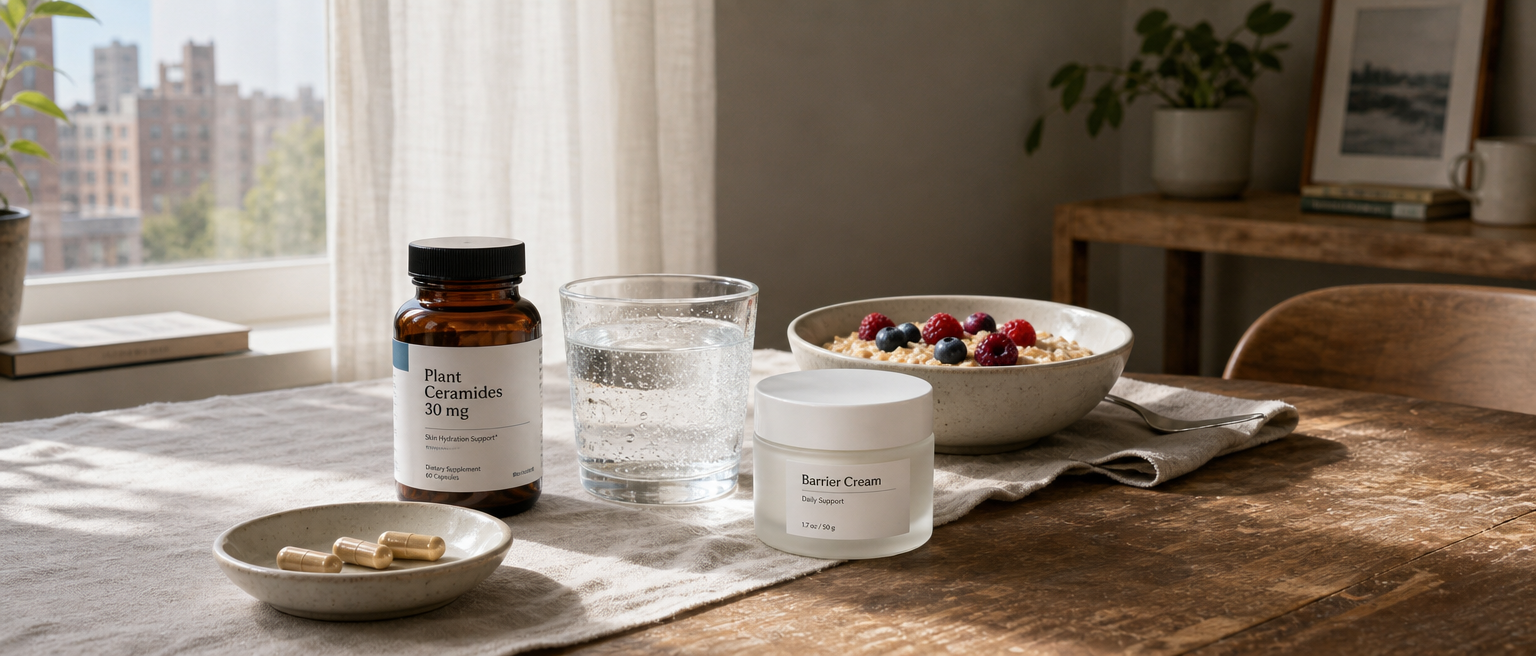
Oral ceramide products vary quite a bit. Some contain plant-derived glucosylceramides from wheat or rice. Others use dairy-derived sphingomyelin, wine-lees extracts, microbial dihydroceramide, or mixtures of polar lipids.
After digestion, these compounds are partly broken down and absorbed. In a rat study using radiolabeled ceramide, some absorbed material later appeared in the skin and gradually moved from the dermis toward the epidermis. That supports the biological plausibility of oral ceramide supplements, although rat distribution data cannot tell us how much benefit a person will feel or see.
The proposed effect is not like sunscreen. Ceramides do not sit on top of the skin and block UV rays. The idea is slower and more indirect: by improving barrier lipids, water retention, and possibly inflammatory signaling, they may help skin stay more resilient under stress. If that effect exists in humans, it likely builds over weeks, not hours.
3. What the evidence says
The strongest human evidence for oral ceramide-related supplements is in dry skin, hydration, and barrier markers, rather than sun exposure.
A systematic review and meta-analysis of dietary supplements for skin moisturizing included 66 randomized controlled trials overall and identified 11 ceramide trials. As a single ingredient category, oral ceramides were linked with better skin hydration and lower TEWL compared with placebo. That is encouraging, but the review also pointed out common weaknesses: small studies, varied ingredients, unclear reporting, and possible conflicts of interest.
Several individual human studies point in the same general direction. A wheat extract oil trial in women with dry to very dry skin found improved hydration after three months. A 2023 trial of wheat polar lipids in women with dry skin and mild-to-moderate skin aging reported improvements in hydration, elasticity, smoothness, roughness, wrinkle depth, and TEWL over 56 days, though the benefits were not maintained after stopping.
Other studies are more mixed. A wine-lees extract providing ceramides and glucosylceramides reduced forearm TEWL after 12 weeks, but hydration and symptom scores did not clearly differ from placebo. A dairy-derived sphingomyelin trial improved upper-arm hydration, but not TEWL. A dihydroceramide study found better stratum corneum hydration, especially at exposed sites such as the cheek and neck, but no significant between-group difference in TEWL.
For UV-specific outcomes, most of the evidence comes from animals:
- In hairless mice, oral glucosylceramide given before UVB exposure reduced TEWL after barrier injury and increased TGase-1, an enzyme involved in forming the skin’s outer protective envelope.
- In another mouse study, dietary milk sphingomyelin helped suppress the UVB-related rise in TEWL and the drop in stratum corneum water content. It also helped maintain specific bound ceramides and reduced inflammatory gene signals.
- Studies using sphingomyelin-rich milk phospholipids or oral ceramide in UVB-exposed mice reported improvements in skin ceramide balance, inflammation-related pathways, pigmentation, epidermal thickening, and moisture.
 Dry-skin data: Human trials suggest better hydration and sometimes lower TEWL.
 UV outcomes: Human data on sunburn, UV injury, and recovery are still missing.
 Preclinical signal: Animal studies suggest barrier and inflammation effects after UVB.
These findings are interesting because they fit the biology: UVB can disturb the barrier, and ceramide-related ingredients may help preserve some of that barrier structure in animals. But they are not enough to say oral ceramides are proven oral photoprotectants in people.
4. Practical considerations
If someone chooses to try oral ceramides for skin barrier support, the most realistic expectation is a gradual improvement in dryness or hydration over 6 to 12 weeks. That is the time frame used in many human studies.
There is no universal evidence-based dose for sun protection. Research uses different ingredients and amounts, including wheat polar lipid complexes, wheat extract oil, rice ceramides, wine-lees ceramides, dairy sphingomyelin, microbial dihydroceramide, and milk phospholipid mixtures. Results from one product cannot automatically be applied to another.
It is also worth keeping the goal clear. Oral ceramides may support the barrier in a general sense, but they should not be used instead of sunscreen, shade, hats, sunglasses, or protective clothing. They should not be treated as an acute “after-sun repair” supplement either. Human studies do not show that taking ceramides after a sunny day quickly reverses sunburn or repairs UV-induced DNA damage.
5. Safety
Short-term safety in healthy adults looks generally reassuring in the available trials. Several studies reported no supplement-related adverse events, and in others, adverse events occurred in both placebo and supplement groups without being attributed to the test product.
Still, the safety picture is incomplete. Many trials excluded people who were pregnant or breastfeeding, smokers, people with major illness, people with active skin disease, and those with relevant food allergies. Long-term use, use in children, and use in medically complex groups are not well studied.
Source-specific cautions are important. Dairy-derived sphingomyelin products are not suitable for people with milk allergy. Wheat-derived products may not suit people with wheat allergy, and anyone avoiding gluten should check the exact product, testing, and allergen information rather than assuming all wheat-derived lipid extracts are gluten-free. As with any supplement, ingredient quality, dose, and formulation vary.