

 Deutsch
 Español
 Suomi
Suomi Français
 Bahasa Indonesia
 Italiano
 日本語
日本語 Português
 Tagalog

1. What copper does in skin
Copper is a trace mineral, which means the body needs only tiny amounts of it. In the skin, though, those small amounts do useful work: copper helps specific enzymes function properly.
One of the most relevant enzymes for sun-exposed skin is lysyl oxidase. It helps cross-link collagen and elastin, the protein fibers that give skin its firmness, stretch, and structure. UV exposure gradually damages these fibers and changes the way skin repairs them, which is one reason photoaged skin can become thinner, looser, or more wrinkled over time.
Copper is also part of copper-containing superoxide dismutase, an antioxidant enzyme that helps neutralize reactive oxygen species. Because UV light increases oxidative stress in skin, this pathway often comes up in discussions of copper and photoaging.
Copper also contributes to tyrosinase activity, which is involved in melanin formation. Melanin is the pigment that gives skin its color and helps absorb some UV radiation. That does not make copper a sunscreen, but it helps explain why copper deficiency can be linked with changes in pigmentation.
2. How copper might influence sun-exposed skin
The theory is fairly simple: when copper is too low, some of the skin’s repair and resilience systems may not work as well. Collagen and elastin cross-linking may be less efficient, antioxidant enzyme activity may be weaker, and pigmentation may change.
A controlled feeding study in young men offers one of the clearest human clues. When copper intake was lowered, skin lysyl oxidase activity fell by 24%. When copper was reintroduced, the enzyme activity moved back toward baseline. This does not prove that copper supplements repair sun damage, but it does show that copper intake can affect a skin enzyme tied to structural strength.
Severe copper deficiency is uncommon, but it can cause connective-tissue problems and hypopigmentation. People at higher risk include those with certain malabsorption conditions, people taking very high-dose zinc, and some people after bariatric surgery. For these groups, correcting a deficiency is very different from taking extra copper for beauty or sun repair.
3. What the evidence says about supplements
For oral copper supplements, the research is less impressive than the biology. Practical sources such as the NIH Office of Dietary Supplements describe copper’s roles and intake targets, but they do not show that extra copper improves UV-related outcomes in people who already meet their needs.
Across the available research, there are no strong randomized human trials showing that copper supplementation prevents sunburn, reduces UV-induced DNA damage, or visibly repairs established photoaging in copper-replete adults.
 Adequacy matters. Too little copper can affect a skin enzyme tied to structure.
 Most adults get enough. Typical diets often meet the 900 microgram daily target.
 More is not safer. Long-term excess can be harmful, especially to the liver.
In practice, copper status is worth looking at when someone has risk factors for deficiency, unexplained low copper, high zinc use, or signs of connective-tissue or pigmentation problems. It is not well supported as a general sun-exposed skin repair supplement.
If you are comparing options for UV-stressed skin, copper should be judged on its own human data. Separate explainers cover vitamin C for sun-damaged skin, green tea polyphenols for sun-exposed skin, and astaxanthin for sun-exposed skin.
4. What about topical copper peptides?
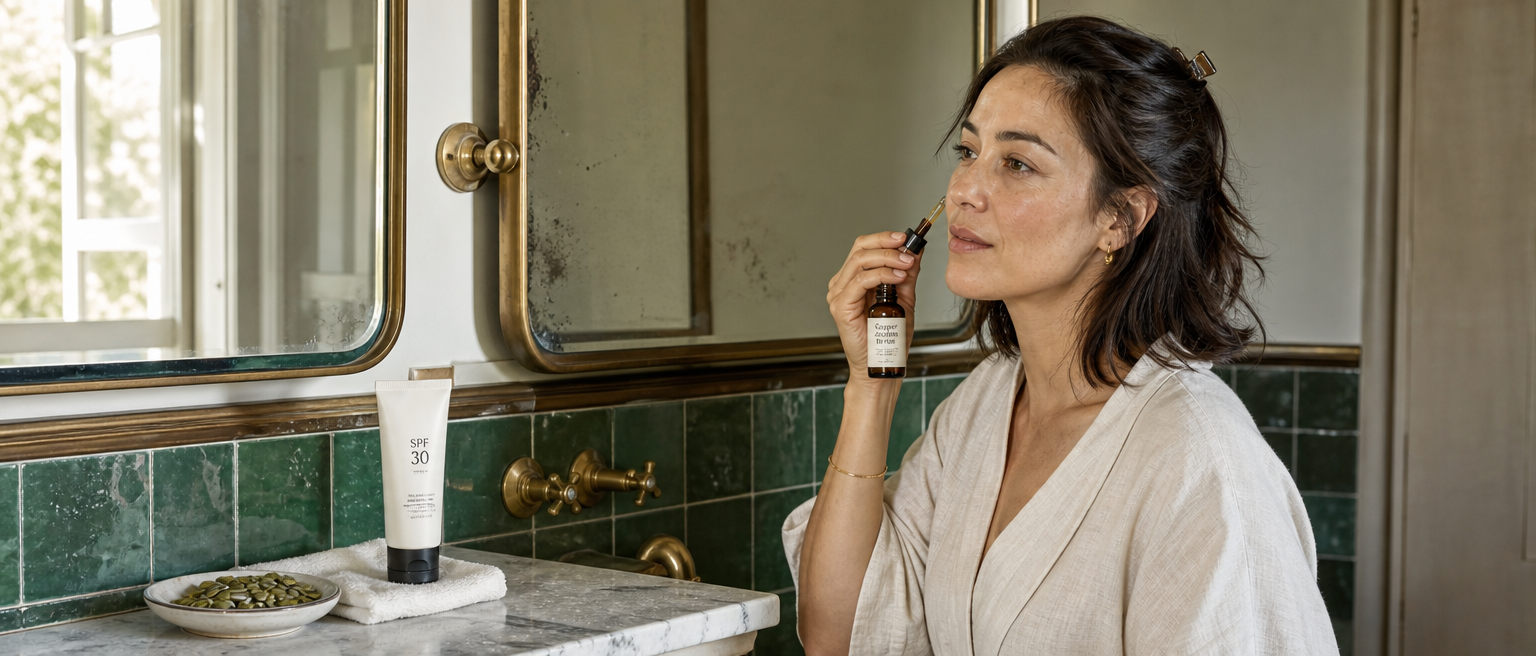
Topical copper peptides are a separate question. Products containing GHK-Cu, also called copper tripeptide-1, are designed to deliver copper locally into skin. Ex vivo human skin research suggests GHK-Cu can be retained in the stratum corneum and epidermis, with relatively limited passage through the skin into the body. That supports the idea that topical copper may act locally rather than simply raising whole-body copper.
Small clinical and cosmetic studies have found signals that copper peptides or copper-containing materials may improve skin appearance, elasticity, or recovery:
- A small randomized trial in 13 people looked at GHK-Cu regimens after CO2 laser resurfacing, a controlled injury-and-repair model. Laser recovery is not the same as ordinary sun exposure, but it is relevant to damaged-skin repair.
- A double-blind study of copper-oxide socks reported improved ankle skin elasticity after four weeks. Useful, but not the same as UV-exposed facial skin.
- A randomized pillowcase study reported improvements in facial skin appearance over time. This is closer to photoaged skin, but it remains a consumer-product study with cosmetic endpoints.
- Reviews of GHK-Cu describe older small studies in photo-damaged skin, including improvements in wrinkle measures and skin density or thickness.
Preclinical work points in the same direction: copper tripeptide-1 has been shown to increase elastin-related activity in fibroblast experiments, including UV-B-exposed cells. Fibroblasts are the skin cells that help maintain the dermal matrix. Still, cell studies cannot tell us whether a serum will produce meaningful changes on a person’s face.
The fair conclusion is that topical copper peptides are plausible and may help some people’s skin appearance, but they are not proven UV repair treatments. They should not replace sunscreen, protective clothing, or evidence-based dermatology care.
5. Practical considerations
For diet, copper is found in oysters and other shellfish, nuts, seeds, legumes, whole grains, and organ meats. If your diet is varied, deficiency is unlikely.
The adult RDA is 900 micrograms per day. The adult tolerable upper intake level in the U.S. is 10,000 micrograms, or 10 milligrams, per day. EFSA uses a more conservative safety framing, noting no expected copper retention up to 5 milligrams per day and a safe level of 0.07 milligrams per kilogram of body weight per day for adults.
Read labels carefully. Some copper supplements contain amounts far above the daily requirement, and some products on the market may provide up to 15 milligrams, which is above the U.S. adult upper limit. If a multivitamin already contains copper, adding a separate copper supplement can push intake higher than intended.
Also keep an eye on zinc. High-dose zinc can reduce copper absorption and, over time, cause secondary copper deficiency. This is one of the more common supplement-related reasons copper comes up in clinical practice.