

 Deutsch
 Español
 Suomi
Suomi Français
 Bahasa Indonesia
 Italiano
 日本語
日本語 Português
 Tagalog

1. What are cocoa flavanols?
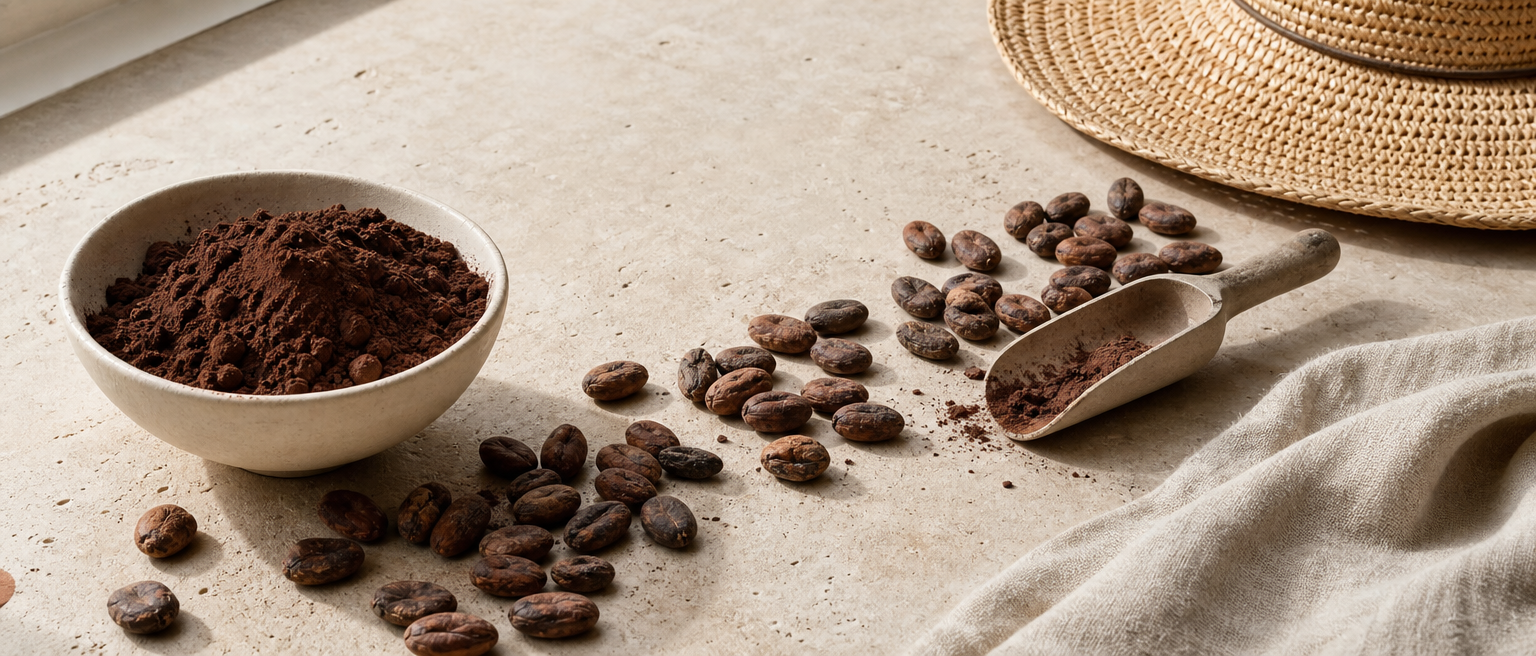
Cocoa flavanols are a family of polyphenols, which are plant compounds found in cocoa beans. The main ones discussed in skin research include epicatechin, catechin, and larger related compounds called oligomers.
This does not mean chocolate protects your skin. Most skin studies used standardized high-flavanol cocoa drinks, powders, supplements, or specially formulated chocolate. Ordinary chocolate can contain very different flavanol levels depending on the bean type, roasting, alkalization, and processing. Some products are high in sugar and fat but low in flavanols.
That difference between products is important. In 2023, the FDA allowed only a narrow qualified cardiovascular claim for high-flavanol cocoa powder and stated that the evidence was very limited. It also clarified that the claim does not apply to ordinary cocoa powder or chocolate products in general. The same practical caution applies to skin: the studies are about cocoa flavanols, not a general reason to eat more chocolate.
2. How they might help skin handle UV
UV light can redden the skin, trigger inflammation, and, over time, contribute to collagen breakdown and photoaging. Cocoa flavanols may affect several of these pathways, although much of the evidence is still indirect.
One of the clearer findings in humans involves blood flow. In a small crossover study of 10 healthy women, a single high-flavanol cocoa drink containing about 329 mg flavanols increased dermal blood flow and oxygen saturation after 2 hours. A low-flavanol cocoa drink did not. Better skin microcirculation could, in theory, help deliver oxygen and nutrients and make skin a little more resilient under stress.
Laboratory and mechanistic research also suggests that cocoa flavanols have antioxidant and anti-inflammatory actions. Reviews describe possible effects on cellular defense systems such as Nrf2 and HO-1, lower inflammatory signaling, and reduced activity of enzymes that break down the skin’s structural matrix. These mechanisms are plausible, but they do not prove that cocoa flavanols prevent real-world sunburn or repair UV injury once it has happened.
3. What the human evidence says
The best evidence is for using cocoa flavanols before UV exposure. Researchers often measure this with minimal erythema dose, or MED: the amount of UV needed to cause visible skin redness. A higher MED suggests the skin is less reactive to a controlled UV challenge.
Several small trials have reported promising results:
- In a 2006 randomized trial, 24 young women drank either high-flavanol cocoa, about 326 mg flavanols per day, or low-flavanol cocoa for 12 weeks. UV-induced redness fell by about 15% at 6 weeks and 25% at 12 weeks in the high-flavanol group. The study also reported improvements in skin roughness, scaling, and hydration-related measures.
- In a 2009 double-blind trial of 30 healthy adults, 12 weeks of flavanol-rich chocolate increased MED, while conventional lower-flavanol chocolate did not.
- In a 2019 nutritional intervention study, 1 week of 1 g per day high-flavanol cocoa was ineffective, but 4 to 6 g per day increased the visible redness threshold and reduced measured redness after UV exposure. This suggests dose may be important, although only 10 people took part.
The strongest note of caution comes from a larger 2014 trial. In 74 women with fair skin, 30 g per day of high-flavanol chocolate supplying 600 mg flavanols was compared with low-flavanol chocolate for 12 weeks. Both groups improved MED by a similar amount, and the difference between groups was not statistically significant. The high-flavanol group did show a small improvement in temple elasticity, but the main photoprotection endpoint was negative.
A 2016 trial in moderately photo-aged women adds another piece to the picture. Over 24 weeks, cocoa flavanol supplementation improved wrinkle depth and skin elasticity compared with placebo, and review summaries also report improved MED. That points more toward possible long-term photoaging benefits than dependable acute sun protection.
Taken together, the findings are encouraging but not settled. Cocoa flavanols may slightly raise the skin’s threshold for UV redness in some settings, but the effect is not consistent enough to rely on for sun protection.
 Small trials: Some report higher MED and less UV redness after weeks.
 Mixed results: A larger 2014 trial did not show better photoprotection.
 Timing matters: Evidence is for regular pre-exposure use, not after-sun repair.
4. Can they help after sun exposure?
Here, the evidence becomes much thinner.
Most human studies gave cocoa flavanols before a controlled UV challenge, then measured redness, blood flow, elasticity, or texture. They did not test whether taking cocoa flavanols after a sunburn reduces pain, speeds peeling, repairs DNA damage, or lowers later skin-cancer risk.
That distinction is important. Preparing the skin over several weeks is different from treating UV injury that has already occurred. Cocoa flavanols may influence inflammation and circulation, so a post-exposure benefit is biologically possible. For now, though, human clinical evidence for after-sun recovery is very weak.
If you are sunburned, the more practical steps are to cool the skin, stay hydrated, use bland moisturizers, avoid further sun, and seek medical advice for blistering, fever, severe pain, or burns over a large area.
5. Practical considerations
The skin trials generally used standardized high-flavanol products, often around 300 to 600 mg cocoa flavanols per day, for 1 to 24 weeks. The EU has authorized a vascular health claim for cocoa flavanols at 200 mg daily from qualifying cocoa beverages or dark chocolate, but that is a blood-flow claim, not a proven skin-protection dose.
If you choose to try cocoa flavanols, look for a product that clearly states its flavanol content. A generic dark chocolate bar may not provide the amount used in trials, and eating enough chocolate to chase a flavanol target can add unnecessary sugar, saturated fat, and calories.
Timing also needs a reality check. The most positive studies used regular intake over weeks, not a single serving before going outside. Cocoa flavanols are better viewed as a possible background nutrition strategy, not something that prepares skin for strong sun at short notice.
6. Safety and who should be cautious
Short-term trial safety looks generally acceptable. The 2014 chocolate trial reported no significant adverse events, and recent reviews of photoaging supplement trials describe interventions up to 24 weeks as appearing safe overall.
Still, real-world use comes with caveats. Cocoa and chocolate can contain caffeine and theobromine, which may bother people who are sensitive to stimulants. Chocolate-based products can also add sugar, fat, and calories. The FDA has discussed concerns about lead and cadmium contamination in some cocoa and chocolate products, so product quality is not a minor detail.
People who are pregnant, breastfeeding, managing migraines or reflux, sensitive to caffeine, or taking medication should check with a clinician before using concentrated cocoa flavanol supplements. Anyone with a cocoa allergy should avoid them.